Why is CCT unsuitable for some monochromatic light measurements?
Product Measurement
Measuring Monochromatic Light
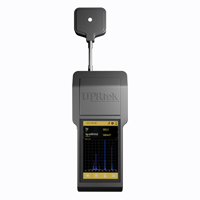
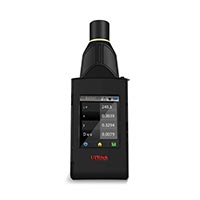
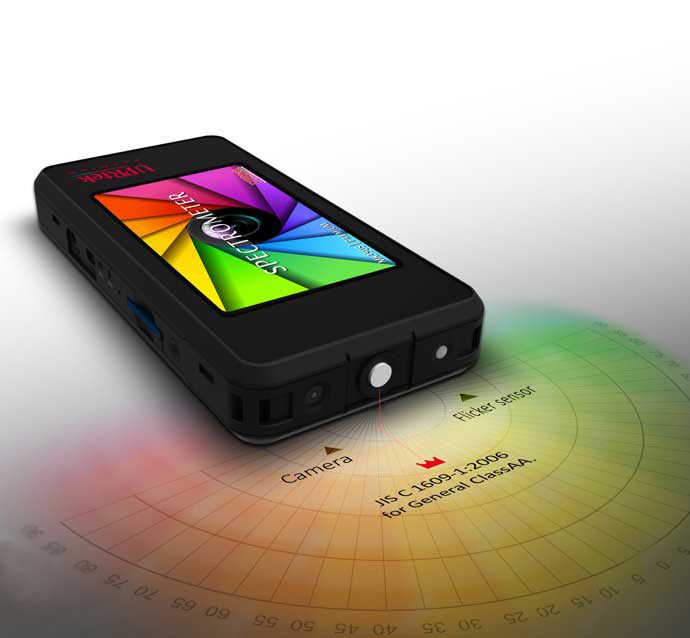
Since the LED monochromatic light source does not belong to color judgement of white light. Therefore, when you are using UPRtek handheld spectrometer measure a monochromatic light source, you will encounter following situations:

| Item | Monochromatic light | Isotemperature Lines | Correlated Color Temperature |
|---|---|---|---|
| Case 1 | Amber Light | Inside the range | V |
| Case 2 | Red Light | Outside the range | X |
| Case 3 | Green Light | Inside the range | V (*Remark) |
| Case 4 | Blue Light | Outside the range | X |
The following reference data of the practical cases are using uSpectrum PC software for further analysis, which are measured by UPRtek handheld spectrometer for four kind of monochromatic lights:
Case 1 : Amber Light
Amber Light – The chromaticity coordinates is inside the range of isotemperature lines,the Correlated Color Temperture (CCT) value is 1805K.

Case 2 : Red Light
Red Light – The chromaticity coordinates is outside the range of isotemperature lines, the Correlated Color Temperture (CCT) value is 0K.

Case 3 : Green Light
Green Light – The chromaticity coordinates is inside the range of isotemperature lines, the Correlated Color Temperture (CCT) value is 7754K.

Case 4 : Blue Light
Blue Light – The chromaticity coordinates is outside the range of isotemperature lines, the Correlated Color Temperture (CCT) value is 0K.

Therefore, when measuring monochromatic light, users should not refer the parameter of Correlated Color Temperture (CCT) for color judgement. It is recommended to use CIE 1931 x, y or Lambda d and Purity parameters to determine monochromatic light.

*Remark
The CIE recommends that the concept of correlated color temperature should not be used if the chromaticity of the test source differs more than below calculation from the Planckian radiator. Users may check Duv paramaters from uSpectrum Data column.

Resource
https://en.wikipedia.org/wiki/Color_temperature